
What Is a DSCR Loan? How It Works in 2026
If you've been priced out of conventional investment-property loans by income documentation, you're not alone — and you're exactly who the DSCR loan was built for.
A DSCR loan qualifies the property, not you. Instead of pay stubs, tax returns, and a debt-to-income calculation, the lender looks at one question: does the rent cover the mortgage? For investors building a portfolio, that single shift changes what's possible.
This guide covers what a DSCR loan is, how the ratio is calculated, what it takes to qualify in 2026, and where it fits against the other ways to finance a rental. If you already know the basics and just want terms, you can see Alta's DSCR program or start an application.
What a DSCR loan actually is
DSCR stands for Debt Service Coverage Ratio — a measure of whether a property's income covers its debt. A DSCR loan is a long-term rental loan that underwrites the deal on that ratio instead of on your personal income.
The core idea: if the property pays for itself, the property qualifies — regardless of what your tax returns say.
That makes it a fundamentally different product from a conventional mortgage:
- No personal income verification. No W-2s, no tax returns, no DTI ratio.
- Qualification is property-first. The rent (actual or market) is weighed against the loan payment.
- Property-first, not property-only. Credit and experience still matter. We lead with the property's cash flow, but we also look at your credit score and your track record as an investor — they shape your terms and pricing.
- Built for investors, not owner-occupants. These are business-purpose loans for non-owner-occupied rentals.
- Long-term by design. Typically 30-year terms, so they're a hold tool, not a short-term bridge.
For a self-employed investor, someone with heavy write-offs, or anyone past the conventional limit on financed properties, that's the difference between scaling and stalling.
How DSCR is calculated
The ratio itself is simple:
DSCR = Net Operating Income ÷ Debt Service
For residential rentals, most lenders use a more direct version:
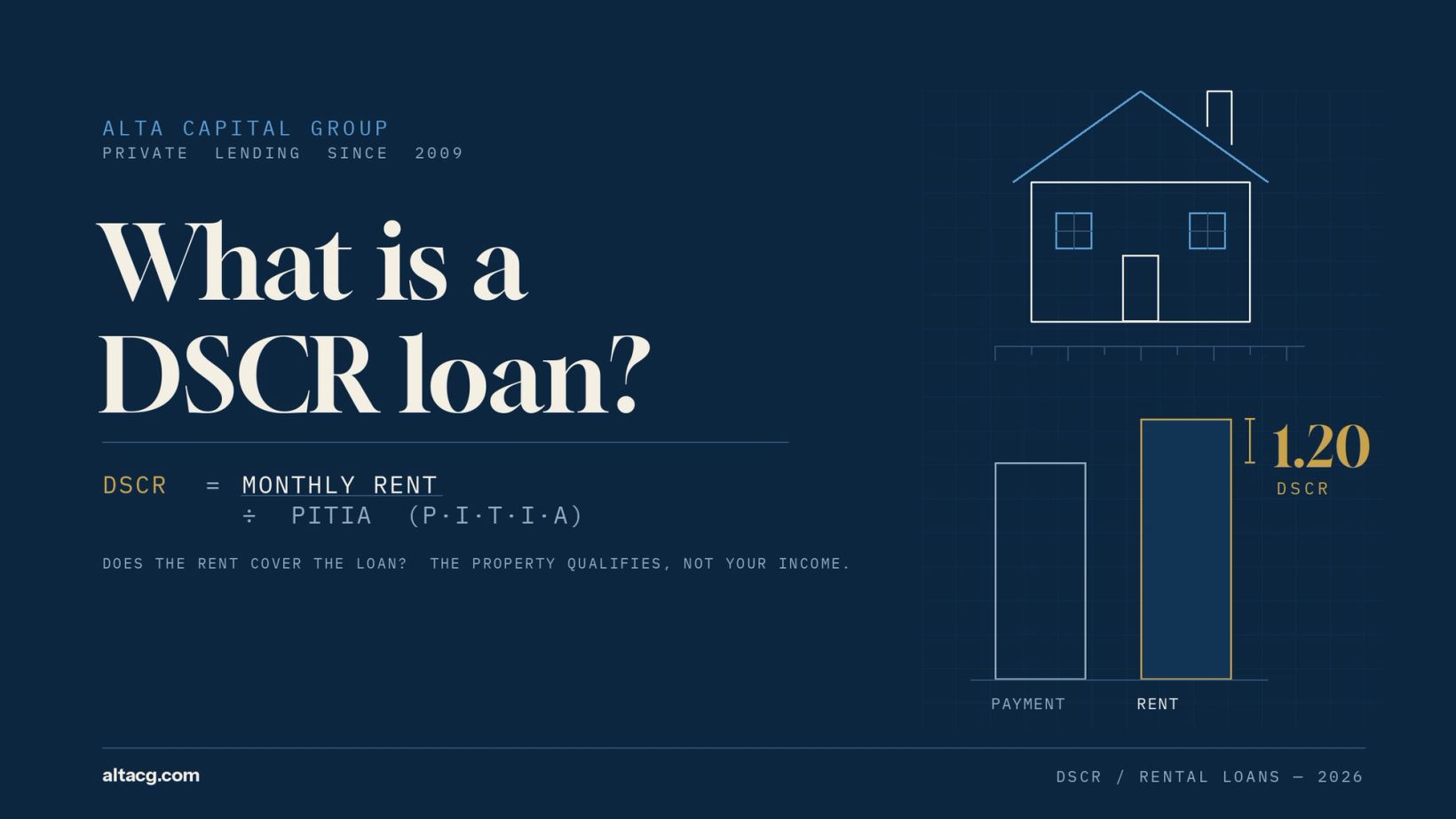
DSCR = Monthly Rent ÷ PITIA
PITIA is the full monthly payment — Principal, Interest, Taxes, Insurance, and Association dues (HOA, if any).
Here's a worked example:
- Monthly market rent: $2,400
- Monthly PITIA (loan payment + taxes + insurance): $2,000
- DSCR = 2,400 ÷ 2,000 = 1.20
A DSCR of 1.20 means the property generates 20% more income than it costs to carry. The higher the number, the more cushion the deal has — and the better your terms tend to be.
A few things that trip up first-timers:
- A DSCR of 1.0 is break-even. Rent exactly equals the payment. Many lenders, Alta included, will work with deals at 1.0+, but stronger ratios open better pricing.
- Below 1.0 means negative cash flow. Some programs allow sub-1.0 ratios with compensating factors (lower LTV, reserves), but you're now relying on appreciation, not cash flow.
- Rent is usually the lesser of actual or market. Lenders order an appraisal with a rent schedule (Form 1007) to confirm market rent, so an inflated lease won't carry a weak deal.
For a deeper walkthrough with more scenarios, see How DSCR Is Calculated (coming soon).
What counts as a "good" DSCR
There's no universal cutoff, but here's how ratios generally read:
- 1.25 and above — strong. Best pricing, widest lender appetite.
- 1.10 to 1.24 — solid. The bread-and-butter range for most approved deals.
- 1.00 to 1.09 — workable. Qualifies with many lenders; expect slightly tighter LTV or pricing.
- Below 1.00 — case-by-case. Possible with compensating factors, but the property isn't covering itself.
The right target depends on your market. In high-rent, lower-price metros, 1.25+ is realistic. In appreciation-driven coastal markets, investors often accept ratios near 1.0 and bank on equity growth.
DSCR loan requirements in 2026
Requirements vary by lender, but a typical DSCR loan looks for:
- DSCR of 1.0 or higher (some programs go lower with offsets).
- Down payment of typically 20–25%, i.e. often up to around 80% LTV on a purchase.
- A qualifying credit score — minimums vary by lender and program and move with the market, so check the DSCR program page for current requirements; stronger credit typically earns better pricing.
- Cash reserves, often 3–6 months of PITIA.
- A non-owner-occupied 1–4 unit residential property, condo, or eligible short-term rental — held in an LLC or personal name.
- An appraisal with a market-rent schedule to confirm the income side.
What you don't need is just as important: no personal income documentation, no employment verification, and no DTI ceiling. That's the whole point.
A note on the numbers above: LTV limits, minimum FICO, and reserve requirements move with the market and vary by program, so treat them as general guidance, not a guarantee. For Alta's current requirements — and terms like 30-year amortization, DSCR 1.0+, and no income verification — check the DSCR program page or talk to a lender. A full breakdown lives in DSCR Loan Requirements & How to Qualify (coming soon).
DSCR vs. conventional investment-property loans
Both can finance a rental. They qualify you completely differently:
- Qualification. Conventional underwrites you — income, DTI, tax returns. DSCR underwrites the property's cash flow.
- Property count. Conventional financing typically caps you around 10 financed properties. DSCR programs generally don't, so they're the tool for scaling a portfolio.
- Speed and paperwork. DSCR files are lighter — no income docs to chase — so they often close faster.
- Rate. Conventional usually prices a bit lower for a borrower who qualifies cleanly. DSCR trades a small rate premium for flexibility and no income hurdle.
- Entity ownership. DSCR loans readily allow title in an LLC, which conventional lenders often resist.
The honest summary: if you have clean W-2 income and only need one or two properties, conventional may price better. If you're self-employed, write a lot off, or are building a portfolio, DSCR is usually the path. We compare them head-to-head in DSCR vs. Conventional Investment Property Loan (coming soon).
Why DSCR demand is surging in 2026
DSCR isn't a niche workaround anymore — it's a core tool investors build strategies around. The 2026 backdrop explains why:
- Volume is climbing fast. Industry DSCR loan volume rose roughly 54% year over year in Q1 2026, even as other loan types grew slowly.
- Rates have improved. DSCR rates dipped below 7% in early 2026 for the first time since mid-2022, with most loans pricing in the 6% range — narrowing the gap with conventional.
- Investors are buying. Investors purchased roughly a third of all single-family homes sold in 2025, the highest share in years, and most of those holds need investor-friendly financing.
- Thin flip margins are pushing capital into rentals. With fix-and-flip ROI at a 17-year low, more operators are holding properties as rentals — and DSCR is how they finance the hold.
If you're flipping today and thinking about keeping the next one, the BRRRR method (coming soon) and DSCR financing are how that pivot works in practice.
Where DSCR loans fit in your strategy
A few of the most common plays:
- Buy-and-hold rentals. The classic use — finance a cash-flowing rental on its own income.
- Portfolio scaling. Once conventional financing caps out, DSCR keeps you buying.
- Cash-out refinance. Pull equity out of a stabilized rental to fund the next deal. Note that cash-out LTV caps tightened in recent years (commonly 70–75%) and most lenders require 90–180 days of seasoning. See DSCR Cash-Out Refinance (coming soon).
- Fix-to-rent (the BRRRR exit). Buy and renovate with a fix-and-flip or bridge loan, then refinance into a 30-year DSCR loan once it's stabilized and rented. This "one-stop" path is one of the most common reasons investors come to a lender that does both.
- First-time investors. No income docs lowers the barrier for newer investors with a strong deal. See DSCR Loan for First-Time Investors (coming soon).
DSCR loan rates and terms
What to expect on a DSCR loan in 2026:
- Term: typically 30-year amortization; interest-only options on some programs.
- Rate: generally a modest premium over a comparable conventional rate; driven by your DSCR, LTV, credit, and property type. Stronger ratios and lower leverage usually earn better pricing.
- LTV: often up to around 80% on purchase; typically lower on cash-out refinances.
- Fees: origination points plus standard closing costs; prepayment penalties (often a step-down structure) are common on DSCR loans — ask how yours is structured.
Rates, LTV caps, and FICO minimums all move with the market, so the most useful thing isn't a number in an article — it's a current quote on your actual deal. For where things stand today, check the DSCR program page or talk to a lender and we'll price the specific property.
The honest trade-offs
DSCR loans are powerful, not perfect. What to weigh:
- The good: no income docs, portfolio-friendly, LLC-friendly, faster files, and qualification driven by the deal itself.
- The cost: a slightly higher rate than conventional, larger down payments than owner-occupied loans, and prepayment penalties to plan around.
- The catch: the property has to actually cash flow. If the rent doesn't cover the payment, a DSCR loan won't paper over a weak deal — and that's by design.
That last point is a feature. The ratio keeps you honest about whether the deal works.
How Alta approaches DSCR
We've been a direct private lender since 2009, and we underwrite DSCR loans the way operators actually think — against the property, the rent, and the exit, not a checklist of pay stubs you don't have.
- No income verification — but not no underwriting. We qualify the property's cash flow first, and we still weigh your credit and investing experience to structure the right terms.
- Built for portfolios. Title in your LLC, no conventional property-count cap.
- A real human on every deal. A dedicated account manager who picks up the phone, not a portal that goes quiet.
- One lender across the deal lifecycle. Acquire and renovate on a bridge or fix-and-flip loan, then refinance into a 30-year DSCR hold — without changing lenders.
If you've got a rental that pays for itself, the financing shouldn't be the hard part.
Have a deal? Let's get it closed. Start an application or talk to a lender — every deal starts with a conversation, not a form letter.
Alta Capital Group is a direct private lender offering bridge, fix-and-flip, new construction, DSCR/rental, and multifamily loans to real estate investors and brokers nationwide. Loan terms and availability vary by state and program; your account manager confirms eligibility on the first call. This article is educational and not financial or legal advice.